Sarcoids
Between 12th July and 15th September 2015, Michael received weekly AZ sessions.
Michael had four sarcoids: a large, open lesion above his right eye, a smaller sarcoid on his right cheek, and two thumbnail-sized sarcoids beneath his right elbow crease and on his left inner thigh. Previous veterinary treatment using bloodroot ointment had failed, and his case had been referred to the University of Liverpool for radiation therapy. It was feared that he would likely lose his eye. Instead of proceeding with radiation, a decision was made to explore self-medication.
Ingraham student, Tay Paul was asked to attend and assess whether Michael could guide his own healing. Tay’s sessions were supported daily by Michael’s guardian, Karen, who consistently offered key extracts according to the principles of self-selection. Although the sarcoids were the obvious physical focus, addressing the emotional state can often also be needed, especially if sarcoids appear within a year of a traumatic experience. Early in the work, when angelica root was offered directly to the sarcoid above Michael’s eye, he moved his head away. Respecting this, Tay instead offered it to the foot, working through an acupressure point corresponding to the same meridian. As the oil was applied distally, blood began to trickle from the sarcoid above the eye, an immediate and unexpected response. At this point, Karen did not see any physical changes, but did notice that his personality seemed more communicative, outward and engaged. There also appeared to be positive changes with his body awareness and movement.
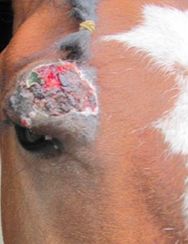
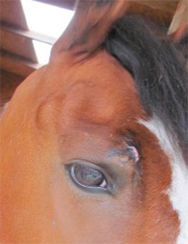
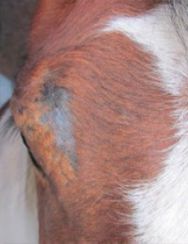
Michael selected between one and three kilograms of rosehip shells per day, often alternating sequentially with barley grass. Barley grass intake averaged around 50 grams daily, sometimes rising to 100 grams, and was frequently chosen dry. During sessions, Michael also selected lemon peel powder, typically between two and eight tablespoons. In the earlier stages, he also chose calendula infused oil orally, taking anywhere from 5 to 100 ml at a time. Despite taking such large quantities of nutrients and working with the photoreactive oils, the first visible sign of a resolution didn’t occur till into the second month of treatment, when the left inner thigh sarcoid disappeared completely. Two weeks later, the large sarcoid above the eye began to change more rapidly, flattening and reducing in size. This phase coincided with Michael selecting and allowing consistent topical application of photoreactive essential oils directly onto the large sarcoid. Notably, no topical treatment was applied to the three smaller sarcoids at any stage. The sarcoid above Michael’s eye had completely resolved, leaving only a gradually softening scar with fine new hair growth, and his eye was fully preserved.
By session twelve, Michael lost interest in the photoreactive essential oils that had previously been central to his selections. His engagement with barley grass and rosehip shells also became less frequent. At the same time, his focus shifted toward topical extracts associated with scar tissue repair, signalling a clear transition from active resolution to consolidation and healing.
From late October 2015 through February 2016, Michael continued to receive fortnightly Applied Zoopharmacognosy sessions. Daily quantities of rosehip shells and barley grass fluctuated, with occasional refusal, another indication that his needs were diminishing rather than persisting. The three smaller sarcoids did not return. Over this period, the sarcoid above the eye completely resolved, leaving only faint scar with fine new hair growth. His interest in calendula shifted to topical application on the healing skin, often in combination with German chamomile and lavender essential oils. Michael retained full use of his eye, and no further intervention was required.
