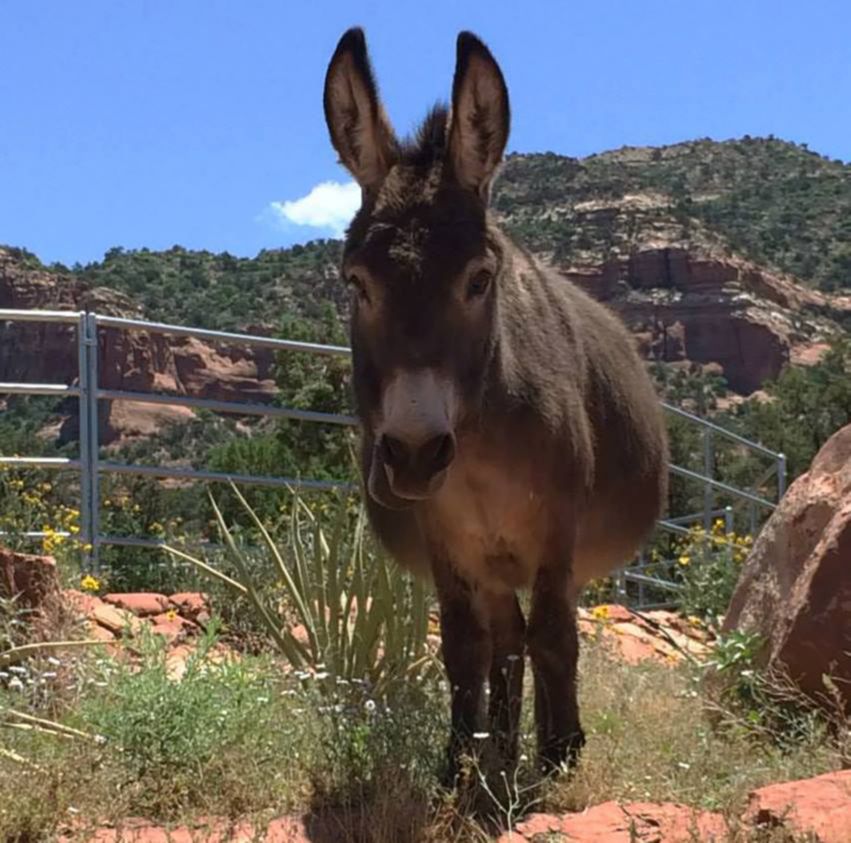
A donkey facing euthanasia,
vets were at a loss
Eyore, a rescued donkey estimated to be 21 years old, arrived at the Sedona Double H Equine Foundation and Sanctuary in September 2014. His early life had been marked by severe neglect, confined to a barren enclosure with inadequate sustenance. Upon arrival, it was clear that Eyore had endured significant hardship. His dental health was dire, requiring the removal of all his front teeth, leaving only his molars for chewing. Remarkably, he adapted by using his gums to graze on grasses. Eyore also suffered from chronic diarrhoea. Through dedicated care and attention, he gradually regained his health and vitality, until April 2017, when his condition began to decline.

Blood tests revealed a low-grade infection and elevated liver enzyme levels. To address this, a course of antibiotics was administered through his feed. After several months, his health appeared to stabilize. However, later that year, Eyore exhibited persistent lethargy and began consuming excessive amounts of juniper berries, prompting further blood tests. The results showed a lingering mild infection. The veterinarian suspected age-related pulmonary issues, compounded by a weakened immune system struggling against an underlying viral presence.
Eyore's condition fluctuated, good days followed by bad ones, and he often became depressed, lying down for long periods. Vet visit after vet visit yielded no real diagnosis. His condition got worse when the weather got colder, and his appetite became almost non-existent. Although ulcer medication improved his appetite slightly, each day was an adventure in getting Eyore to eat. Vitamin B shots provided temporary boosts, but his overall decline suggested he was nearing the end of his life. Blood tests continued to indicate a low-grade infection and anaemia - the vet suspected some internal bleeding, possibly as a side effect of the pain medications.
The Turning Point
In early April 2018, Eyore became uncharacteristically aggressive when touched, prompting X-rays. These revealed two fused vertebrae at the base of his skull, arthritis in his neck and shoulders, and likely arthritis in his hips and hocks. He began a regimen of Previcox for pain and UlcerGard to protect his stomach. While this provided some relief, his poor appetite persisted, and sores on his hocks from constant rubbing refused to heal, despite bandaging, the sores. Although not infected, they were oozing and reluctant to heal. I met Eyore in July 2018 and gave him the opportunity to self-medicate. I offered nutrient-rich barley grass powder, rosehip shells, and a selection of dried herbs, including nettle, concentrated liquorice root, marigold flowers, chamomile flowers, and comfrey.
Eyore showed a strong preference for liquorice root, known for its hepatoprotective properties, and an interest in comfrey and marigold, but to a lesser degree. Being guided by her selection of liquorice root, I then introduced lime essential oil, as it is known for liver supporting properties. Rather than licking the oil, Eyore deliberately pressed his head, shoulders, hips, and hocks against the oil, perhaps for its liver supporting properties or for its ability to help dissolve joint calcifications. He pushed firmly and with clear intent. Following this, he selected a small amount of arnica CO2 and wintergreen applied to his arthritic joints. For his wounds, while initially showing interest in yarrow, he rejected it when it was offered to be applied topically, instead he preferred green clay, which was liberally applied to his sores with great success.
Eyore’s primarily focus had been in remedies aligned with liver support, antiviral and antibacterial oils such as garlic, and pain-relieving remedies. At the end of the session I asked if Diana would offer Eyore his mash. He ate two bowls with enthusiasm, the most he had eaten in months! Even though it was evident that he had keen interest for more, we did not want him to overdo it and get colic. As an additional safeguard, I left Diana equipped with peppermint, fennel, and German chamomile, oils that are typically selected for colic management. I also prepared 5-liter buckets of water infused with lime, melissa, thyme, wild carrot seed, and wintergreen essential oils, allowing Eyore to self-administer as needed. Fresh water was also available. Overnight, Eyore’s preference had been for wild carrot seed as the bucket was almost empty. This was an unexpected outcome given that he had shown the least interest in it compared to his other chosen oils. Wild carrot seed essential typically helps support liver function and repair. In the morning Eyore greeted us with a renewed vitality, eating another two bowls of mash, his transformation filled the sanctuary with a sense of elation.

Two weeks later Diana reported: “Eyore has been making tremendous progress since his session with you. I am blown away really. I actually cried this morning, as prior to your visit, we were struggling with the decision as to what was best for him, since we had tried so many things, and our vet was at a loss. Eyore now eats with gusto, and the green clay has performed miracles on his wounds. His hock sores are greatly reduced and the ones on his shoulders have almost completely disappeared. His coat is looking much healthier too. Yesterday was the best I have seen him in over a year. He followed along with some of the bigger horses on a hike around the property, actually keeping u p at a trot. Everyone who knows him and has seen him lately has commented on his transformation since your visit. He has also shown an interest in meadowsweet herb, so I am now offering him this as well”.
Three weeks later Diana wrote: “Our vet was in awe, as was a friend of mine from out of state who visited today - she had seen him at his worst. Leslie is from England and is familiar with your work. It was refreshing to use the word “zoopharmacognosy” and have someone understand what I meant. Well, both of them cannot believe the transformation, and the biggest thing everyone notices is the quality of his coat. It is shiny and healthy. He is still eating well but not getting fat, which is also amazing. And trotting all over the place! The years have come off him, and he behaves like a much younger donkey. Oh yes... and to add, I don’t know how this can be but he is not as swaybacked anymore. He used to look almost bent in half, the dip in his back was so low.”
Ongoing Care: “It varies daily as to whether Eyore is more interested in barley grass powder or rosehip shells, but those are his must-have nutrients. He has backed off from the meadowsweet - still eating some but stopped cleaning the bowl and asking for more. However, he has started taking chamomile flowers. The essential oils in water buckets are still available in his stall – carrot seed wild, lime and wintergreen – but he now shows little interest in them, I use about 15 drops per 2.5-gallon bucket. Despite the cold weather Eyore is full of energy, running and bucking alongside the big horses.”
Eyore continued to enjoy a happy and active life until his peaceful passing five years later.”